Disrupting Commerce: Why AI Agents May Be Shopping for You by Christmas
PR Newswire
TAMPA BAY, Fla., June 11, 2026
For years, companies built around deep specialization, layered management, and narrowly defined roles. Cassiano Surek, CTO at Beyond, argues that AI is now breaking that model apart, replacing rigid stacks of specialists with smaller, more versatile teams that move across the full solution stack with AI at their side.
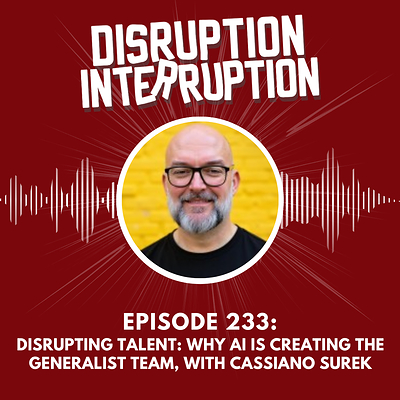
TAMPA BAY, Fla., June 11, 2026 /PRNewswire/ -- AI is no longer just changing what people work on. It is changing who companies need, how teams are built, and how work itself gets organized. With 53% of leaders demanding higher productivity even as 80% of the global workforce says it lacks enough time or energy to do its work, the old specialist-heavy org chart is getting harder to defend. On this episode of Disruption Interruption, host Karla Jo Helms (KJ) speaks with Cassiano Surek, CTO at Beyond, about why hyper-specialized talent is giving way to competent generalists. As Surek puts it, "those very large structures of hierarchy are being contracted quite dramatically."
Why the Specialist Org Chart Is Starting to Break
The old model was built on segmentation: one team for one layer of the stack, one person for one narrow function, and one hierarchy to coordinate the handoffs. That approach made sense when software development required a long chain of specialists. He says that is no longer the case. "Teams are changing from that very specialized lane to more of an amalgamation of competent people that can collaborate and instruct," he explains.
That shift carries structural consequences. Surek argues that once AI tooling allows smaller groups to execute across more of the workflow, people will play distinct roles in different situations. In his words, "You no longer need lots of middlemen to do very specific tasks." The people inside these teams are no longer just coders. They are product engineers at times, builders at times, and problem-solvers across the broader solution.
Adoption is also unfolding at different stages and paces across industries. Smaller, more agile organizations are moving first, while more risk-sensitive sectors like financial services and insurance are moving more cautiously. But in Surek's view, the direction is the same: "It's still risky, but it is better to use it, otherwise you can end up behind the curve." That pressure is what is now pushing AI from experiment to operating model.
Surek's Bet: Smaller Teams, Smarter Tools, and Agentic Commerce
According to Surek, expertise is not disappearing. It is being redistributed. The emerging workforce will still need depth, but it will increasingly reward people who can work across disciplines and direct AI tools effectively. That is what gives the competent generalist an advantage: not shallow knowledge, but wider execution. "People coming in the job market don't come in with that thinking that they would only work in a specific part," he says. "Now, they're going to work across the solutions with a toolkit that will help them achieve a lot more."
The same shift is already spilling into commerce. Agentic commerce is no longer theoretical: AI agents will increasingly act on behalf of users, making decisions, completing purchases, and reshaping the relationship between merchants, brands, and buyers. His example is simple but powerful: if a sought-after pair of running shoes drops at 3 AM, "an agent may buy that for you, on your behalf." Surek believes that may be already happening this Christmas.
At Beyond, that means building for a world where products must be understood not just by humans browsing a screen, but by agents interpreting context, preferences, timing, and constraints. Surek says merchants are already confused about how to prepare for that shift, especially as commerce becomes "less guided by the brand" and "more algorithmically defined." His broader point is that AI is not just changing the interface. It is changing the architecture of work, consumption, and competitive advantage. For the companies willing to keep adapting, that future is not a one-time leap, but "an endless journey of exploration."
Links
Disrupting Talent: Why AI is Creating the Generalist Team, with Cassiano Surek
Disruption Interruption is the podcast where you will hear from today's biggest Industry Disruptors. Learn what motivated them to bring about innovation and how they overcame opposition to adoption.
LinkedIn: https://www.linkedin.com/in/cassianosurek/
Company Website: https://www.bynd.com/
About Disruption Interruption™
Disruption is happening on an unprecedented scale, impacting all manner of industries — MedTech, Finance, IT, eCommerce, shipping, logistics, and more — and COVID has moved their timelines up a full decade or more. But WHO are these disruptors and when did they say, "THAT'S IT! I'VE HAD IT!"? Time to Disrupt and Interrupt with host Karla Jo "KJ" Helms, veteran communications disruptor. KJ interviews badasses who are disrupting their industries and altering economic networks that have become antiquated with an establishment resistant to progress. She delves into uncovering secrets from industry rebels and quiet revolutionaries that uncover common traits — and not-so-common — that are changing our economic markets… and lives. Visit the world's key pioneers that persist to success, despite arrows in their backs at www.disruption-interruption.com.
About Cassiano Surek
Cassiano Surek, CTO at Beyond, is a technology executive, solution architect, and engineering leader whose career has been built at the intersection of AI, commerce, and large-scale digital transformation. He served on Beyond's Global Leadership Team and led an international engineering organization focused on AI, solution architecture, technical sales, and software engineering, helping build multi-million cloud, machine learning, and AI engagements for clients including Google, PayPal, Priceline, Snap, Novartis, Shutterstock, Just Eat, and Got Photo. Based in Lisbon, and originally rooted in software engineering and product delivery, Surek has spent more than two decades building and scaling technical teams across Europe and beyond, with earlier leadership roles at UBIO, Beyond, and WebCertain Tech.
About Karla Jo Helms
Karla Jo Helms is the Chief Evangelist and Anti-PR® Strategist for JOTO PR Disruptors™. Karla Jo learned firsthand how unforgiving business can be when millions of dollars are on the line — and how the control of public opinion often determines whether one company is happily chosen, or another is brutally rejected. Being an alumnus of crisis management, Karla Jo has worked with litigation attorneys, private investigators, and the media to help restore companies of goodwill into the good graces of public opinion — Karla Jo operates on the ethic of getting it right the first time, not relying on second chances and doing what it takes to excel. Helms speaks globally on public relations, how the PR industry itself has lost its way, and how, in the right hands, corporations can harness the power of Anti-PR to drive markets and impact market perception.
References
- Berwick, I. (2025, May 24). What makes a positive difference to the way that staff feel about work? Financial Times. ft.com/content/9e53def2-d5b2-4d89-b385-15df25c3b539
- Kim, E. (2025, November 27). Morgan Stanley expects AI agents to fuel e-commerce boom. Business Insider. businessinsider.com/morgan-stanley-expects-ai-agents-to-fuel-e-commerce-boom-2025-11
- Primack, D. (2025, October 14). Visa launches new "Trusted Agent Protocol" to make AI shopping safer. Axios. axios.com/2025/10/14/visa-ai-shopping-agent-protocol-bot
Media Inquiries:
Karla Jo Helms
JOTO PR™
727-777-4629
 View original content to download multimedia:https://www.prnewswire.com/news-releases/disrupting-commerce-why-ai-agents-may-be-shopping-for-you-by-christmas-302797512.html
SOURCE Disruption Interruption

