Cars attacked by quantum computers? How cybersecurity researchers are preparing for safety threats to vehicles in the quantum era
PR Newswire
ROCHESTER, N.Y., Jan. 12, 2026
Quantum computing will pose a serious threat to vehicle safety and federal agencies are searching for answers. At Rochester Institute of Technology, cybersecurity researchers are helping improve the security of connected vehicles today and in the future.
ROCHESTER, N.Y., Jan. 12, 2026 /PRNewswire-PRWeb/ -- Quantum technology is going to make everything smaller, cheaper, faster, and better. However, it will have at least one unintended consequence—cybersecurity threats.
Quantum computers will make many of the cryptographic methods used in today's secure systems obsolete. While quantum-resistant cryptography is being developed, the changeover process will still put many of the systems that people use every day at risk.
At Rochester Institute of Technology, cybersecurity researchers are preparing for a world with powerful quantum computers by making systems more reliable and safer. Most notably, faculty and student experts are improving the security of connected vehicles. In the process, the team hopes to reduce deaths on the road.
"Quantum-resistant algorithms will eventually help, but they aren't just plug and play—that could break the whole system," said Hanif Rahbari, associate professor of cybersecurity. "The transition from classical cryptography to post-quantum crypto needs to be done with no interruption to the function of systems. People aren't going to sit at home and wait."
Rahbari began researching vehicle-to vehicle (V2V) communication nearly a decade ago. When equipped with this technology, vehicles can wirelessly exchange speed data, location, and alarms to improve traffic flow and prevent accidents. Cryptographic integrity and authenticity are essential for ensuring that messages between vehicles are not malicious.
During his first years at RIT, Rahbari was approached by a group of mathematics and cryptography researchers from the University of Waterloo, Canada. They were developing quantum-resistant algorithms and wanted Rahbari's expertise.
"At first, I wasn't sure how I could contribute to quantum—it felt distant from where I was," said Rahbari. "But not everyone needs to know everything about quantum to be able to work in this multidisciplinary field. We need complementary expertise to collaborate and tackle these problems."
Right away, the team saw that quantum-resistant algorithms could disrupt the safety benefits of connected vehicles. These algorithms bring about a lot of bandwidth, latency, and other overhead issues. For systems with constraints, adding post-quantum crypto could be disruptive and even exploited by attackers.
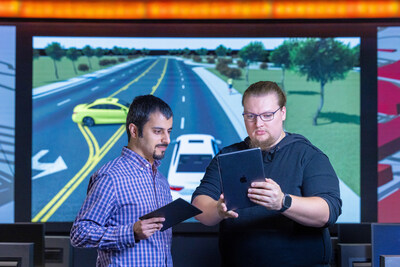
Up on the third floor of RIT's ESL Global Cybersecurity Institute, Rahbari's research group is putting systems and protocols to the test. The work is part of his prestigious National Science Foundation CAREER award, a five-year grant.
While the researchers don't have 100 cars to test on real roads, they are developing an interactive digital twin as a measurement framework. The simulation resembles a racing video game and mirrors the real world.
Geoff Twardokus, an electrical and computer engineering Ph.D. student leading the work, also enjoys using RIT's Faraday Lab. The lab is a radio frequency-shielded space for safe wireless security experiments.
"We're building up to a gold standard of real-world hardware experiments with actual V2V equipment that would be installed in cars," said Twardokus, who is also a 2021 alumnus from RIT's cybersecurity BS/MS programs. "We want to make sure that we can adopt this security without crippling the system that it's supposed to protect."
Congress has passed the Quantum Computing Cybersecurity Preparedness Act to encourage the transition to quantum-resistant cryptography. The National Institute of Standards and Technology (NIST) is currently searching for better cryptographic algorithms designed to withstand cyberattacks enabled by quantum computers.
RIT's team is measuring the impact of different candidates. In 2022, Rahbari, Twardokus, and University of Waterloo experts published research that shed light on the implications of post-quantum cryptography on V2V. That work was cited by NIST in standardizing algorithms.
As a Ph.D. student hoping to become a faculty-researcher in the future, Twardokus noted that the quantum security problem is much broader than vehicle communications. For example, many networking and industrial control systems that manage utilities infrastructure have similar constraints.
"Quantum is an important direction for us to focus on in cybersecurity," he said. "You can develop a really fast quantum chip, but that could actually hurt us more than help us if we don't properly prepare to combat those who might abuse it."
How RIT is Manifesting Quantum:
- Researchers are utilizing quantum in a variety of disciplines to push the boundaries in science, engineering, and technology.
- At RIT, researchers developed the first quantum photonic wafer, which is key to the future of mass-produced quantum communication systems. Experts are also building quantum computing systems and preparing for cybersecurity threats in the quantum era.
- RIT offers an interdisciplinary minor in quantum information science and technology.
Media Contact
Scott Bureau, Rochester Institute of Technology, 585-475-2481, sbbcom@rit.edu, https://www.rit.edu/news/manifesting-quantum
 View original content to download multimedia:https://www.prweb.com/releases/cars-attacked-by-quantum-computers-how-cybersecurity-researchers-are-preparing-for-safety-threats-to-vehicles-in-the-quantum-era-302658478.html
SOURCE Rochester Institute of Technology

